Strength training after 60: why it still works and how to start safely
Trials in people up to their late 90s show that muscle keeps responding to training. This guide is for anyone over 60 starting out, and for the family helping them, with a safe first program that includes the power and balance work most guides skip.
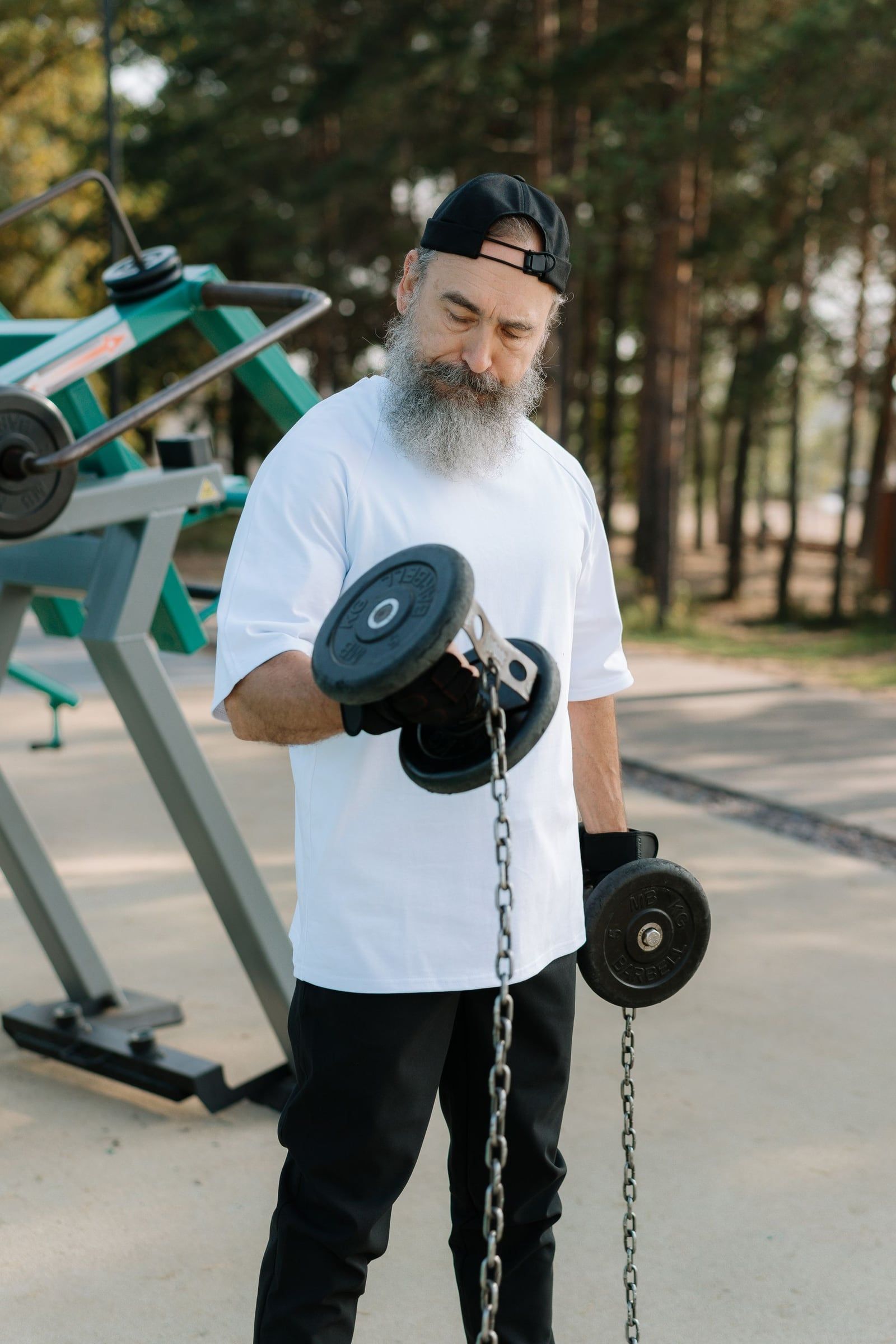
The short answer
Strength training works after 60. Trials in adults over 50 show strength gains averaging roughly 25% to 30%, and frail nursing-home residents in their late 80s and 90s more than doubled their strength in 8 to 10 weeks. A safe start for most people is 2 full-body sessions a week of 1 to 3 sets of 8 to 12 reps, stopping short of failure, plus balance practice on 3 or more days and a few fast lifts for power.
What we know, and how well
Progressive resistance training increases muscle strength in older adults, including people over 80 and frail nursing-home residents.
With age, strength is lost 2 to 5 times faster than muscle mass, and leg power declines faster than strength.
Exercise programs built on balance and functional exercises reduce the rate of falls in community-dwelling older adults by about 24%.
Lifting the weight quickly (power training) improves physical function in older adults slightly more than traditional strength training.
In cohort studies, muscle-strengthening activity is associated with a 10% to 17% lower risk of death from any cause, an association rather than proof of cause.
Training 2 days a week captures most of the strength gain available to older adults, and extra sessions add little.
Contents
- Is it too late to start strength training after 60?
- What happens to muscle as you age?
- Why does strength matter so much after 60?
- How much strength training is recommended after 60?
- How should you train: days, sets, reps and effort?
- What is power training, and why does it matter?
- How do you train your balance?
- Machines, free weights, bands or bodyweight: which is best?
- Should you train with supervision or at home?
- How much protein do you need after 60?
- Is strength training safe after 60?
- What does a beginner session look like?
- How can family members and caregivers help?
- Questions people ask
- References
Strength at 70 is a goal, not a curiosity. Muscle keeps responding to training at every age researchers have tested, into the 90s, and the payoff shows up in the tasks that keep a life independent: rising from a chair, climbing stairs, staying upright. This guide, part of our longevity section, is for two readers at once: someone over 60 who has never lifted, and the family member or caregiver helping them begin.
Is it too late to start strength training after 60?
No. Every age group studied, up to frail nursing-home residents in their late 90s, gets stronger with resistance training1,2,3.
In 1990, 10 frail nursing-home residents aged about 90 nearly tripled their strength after 8 weeks of high-intensity leg training. There was no comparison group4, so the same team ran a randomized trial.
Pooled trials confirm it. Across 47 studies of adults over 50, strength rose by roughly a quarter to a third, from 24% on the chest press to 33% on knee extensions, with larger gains from higher-intensity training5. Age blunts the response somewhat: older participants gained less lean mass than younger ones6, and in 22 trials in people aged 75 and over, strength gains were large, including past 80, while muscle size grew only a little2. Strength responds more than size, and strength decides what you can do.
174%
Average strength gain in frail nursing-home residents aged about 90, after 8 weeks4.
113%
Strength gain with training in a randomized trial of frail adults averaging 87, after 10 weeks1.
1.1kg
Average lean mass gained across 49 resistance training studies in adults over 506.
What happens to muscle as you age?
Muscle mass, strength and power all decline with age, but at different speeds: strength fades 2 to 5 times faster than mass, and power, the ability to produce force quickly, fades faster than strength7,8.
What is sarcopenia?
Sarcopenia is age-related loss of muscle strength and mass that has reached the point of harm. The 2019 European definition (EWGSOP2) calls it a muscle disease, common in older age, and puts low strength first9:
- Probable: low strength, such as grip below 27 kg in men or 16 kg in women, or more than 15 seconds to stand up from a chair 5 times without using the arms.
- Confirmed: low strength plus low muscle quantity or quality on a scan.
- Severe: both, plus poor performance, such as walking at 0.8 m/s or slower.
A family member can time the chair test at home, with a sturdy chair against a wall and someone close by. A result over 15 seconds is worth raising with a doctor.
How fast are strength and power lost?
By age 75, muscle mass falls by about 0.6% to 1% a year, but strength by about 2.5% to 4% a year7. In 1,880 older adults followed for 3 years, leg strength fell about 3 times faster than leg lean mass, and those who gained lean mass still lost strength10. Strength depends on nerves and muscle quality, not just size.
Power drops faster still. Among 100 healthy people aged 65 to 89, strength was about 1% to 2% lower per year of age but leg power about 3.5% lower, and power was linked with chair-rise speed and step height8. Catching a trip and rising from a low sofa are power tasks.
Why do older muscles respond less?
Older muscle shows anabolic resistance: it builds new protein less readily from the same signal. In lab studies, older men’s muscle-building response to lifting was blunted11, and they needed about 0.40 g of protein per kilogram of body weight in a meal to maximize muscle protein synthesis, versus 0.24 g/kg for young men12. These are short-term studies in men, but the message is clear: older lifters need a strong training signal and enough protein at each meal. Exercise helps, too: protein eaten after training was used more for building muscle in young and older men alike13. The biology is covered in how muscles grow.
Why does strength matter so much after 60?
Strength is the reserve that keeps everyday life easy, and losing it predicts disability and death more consistently than losing muscle mass7.
Does strength training help you stay independent?
Yes. In a Cochrane review of 121 trials with 6,700 participants, training had a large effect on strength, a moderate to large effect on rising from a chair, and added about 0.08 m/s to walking speed, though its effect on overall physical ability was small3. In 42 trials in people with sarcopenia (median age 73), resistance exercise, alone or with balance and aerobic work, did most for quality of life, and resistance plus balance training raised walking speed by 0.16 m/s14.
Does it prevent falls?
Yes, as part of a balance-led program. A Cochrane review of 108 trials (23,407 people, average age 76) found exercise cut the rate of falls by 23%: balance and functional exercise by 24%, mixed programs (usually balance plus resistance training) by about 34%, and tai chi possibly by 19%. For programs that were mainly resistance training or walking, the effect was uncertain15. Across 17 trials, fall-prevention exercise also reduced injurious falls by 37% and falls causing fractures by 61%16.
Does it help your bones?
Modestly on average, and more with the right program. Across 75 studies in 5,300 postmenopausal women, exercise raised spine and hip bone density, though effects were small and varied widely17. In the LIFTMOR trial, 101 women around 65 with low bone mass did 8 months of supervised heavy resistance and impact training twice a week (5 sets of 5 above 85% of maximum) or a light home program. Spine bone density rose 2.9% versus a 1.2% fall, hip (femoral neck) density held steady versus a 1.9% loss, and physical function improved more. The women were screened and closely coached, and one minor back spasm was reported18: not a license for unsupervised maximal lifting, but proof that low bone mass need not mean lifting light.
Will it help you live longer?
Possibly, but this evidence is observational. Across 16 cohort studies, muscle-strengthening activities were linked with a 10% to 17% lower risk of death from any cause and of cardiovascular disease, cancer and diabetes, with the largest reduction at about 30 to 60 minutes a week19. Among nearly 100,000 US adults averaging 71, weightlifting was linked to a 9% lower risk of death after accounting for aerobic exercise, and doing both was linked to a 41% lower risk than doing neither20. In 139,691 adults aged 35 to 70 in 17 countries, each 5 kg less grip strength was linked to a 16% higher risk of death over a median of 4 years, a better predictor than systolic blood pressure21. Healthier people are more likely to lift in the first place, so treat these as encouraging associations; the causal case rests on the trials.
How much strength training is recommended after 60?
The World Health Organization (WHO) recommends muscle-strengthening activities at moderate or greater intensity, for all major muscle groups, on 2 or more days a week. For people 65 and over it adds multicomponent activity emphasizing functional balance and strength on 3 or more days, alongside 150 to 300 minutes of moderate aerobic activity a week22. The American College of Sports Medicine (ACSM) also includes muscle strengthening in its exercise prescription for older adults23. The 2021 International Conference on Frailty and Sarcopenia Research (ICFSR) consensus gives the detail24:
| Component | How often | How much | How hard |
|---|---|---|---|
| Resistance training | 2 to 3 days a week | 1 to 2 sets at first, building to 2 to 3 sets of 8 to 12 reps; 6 to 10 exercises for the major muscle groups | Start at 30% to 40% of your 1-rep maximum, progress to 70% to 80% (hard to very hard); 1 to 3 minutes’ rest |
| Power training | Within resistance sessions | Each rep lifted as fast as possible, lowered slowly | 40% to 60% of 1-rep maximum; never to failure |
| Balance training | 1 to 7 days a week | 1 to 2 sets of 4 to 10 different exercises | Progressively harder positions and movements |
The newest ACSM position stand, an overview of 137 systematic reviews in more than 30,000 healthy adults, agrees: resistance training improved strength, muscle size, power, walking speed, balance and physical function, and strength gains were larger with heavier loads (80% of maximum or more), full range of motion, 2 to 3 sets, exercises done early in a session and 2 or more sessions a week25. It covers adults of all ages, so the older-adult trials here remain the main evidence for people over 60.
How should you train: days, sets, reps and effort?
For most beginners over 60: 2 full-body sessions a week, 1 to 3 sets of 8 to 12 reps per exercise, at an effort that feels hard but stops short of failure24,26.
How many days a week?
Two is the sweet spot. In a 24-week trial in 46 adults aged 65 to 79, training 1, 2 or 3 days a week gave similar strength gains (37%, 42% and 40%, versus 4% in controls)27. Across 14 studies in adults over 60, each extra weekly session added little strength and no measurable muscle, so more than 2 sessions is unlikely to add much28. A dose-response meta-analysis also found 2 sessions a week best for strength26.
How many sets and reps?
One set is a legitimate start. In a 20-week trial in adults aged 65 to 78, 1 set of each exercise twice a week improved strength, chair rising, walking and stair climbing, though 3 sets built more strength on some lifts and more endurance29. More volume built more lean mass across studies6, and 2 to 3 sets at 70% to 79% of maximum gave the largest strength effects in a meta-analysis of mostly low-quality trials26.
How heavy, and how hard?
Heavier is somewhat better for strength, but lighter weights work with enough reps. In 15 trials (average age 68), loads around 80% of maximum tended to build more strength than loads around 45%, muscle growth was small either way, and lighter loads still produced substantial strength gains30. ICFSR suggests starting at 30% to 40% of maximum while you learn, then progressing toward 70% to 80%24.
You do not need to train to failure. In the ACSM overview, training to momentary failure did not consistently improve results25, and ICFSR advises against failure in power sets24. A practical rule is to end most sets with 1 to 3 good reps left: the effort stays hard while you avoid the blood pressure spikes of all-out efforts31. Use the full range of motion you can control, and do your priority exercises first25.
What is power training, and why does it matter?
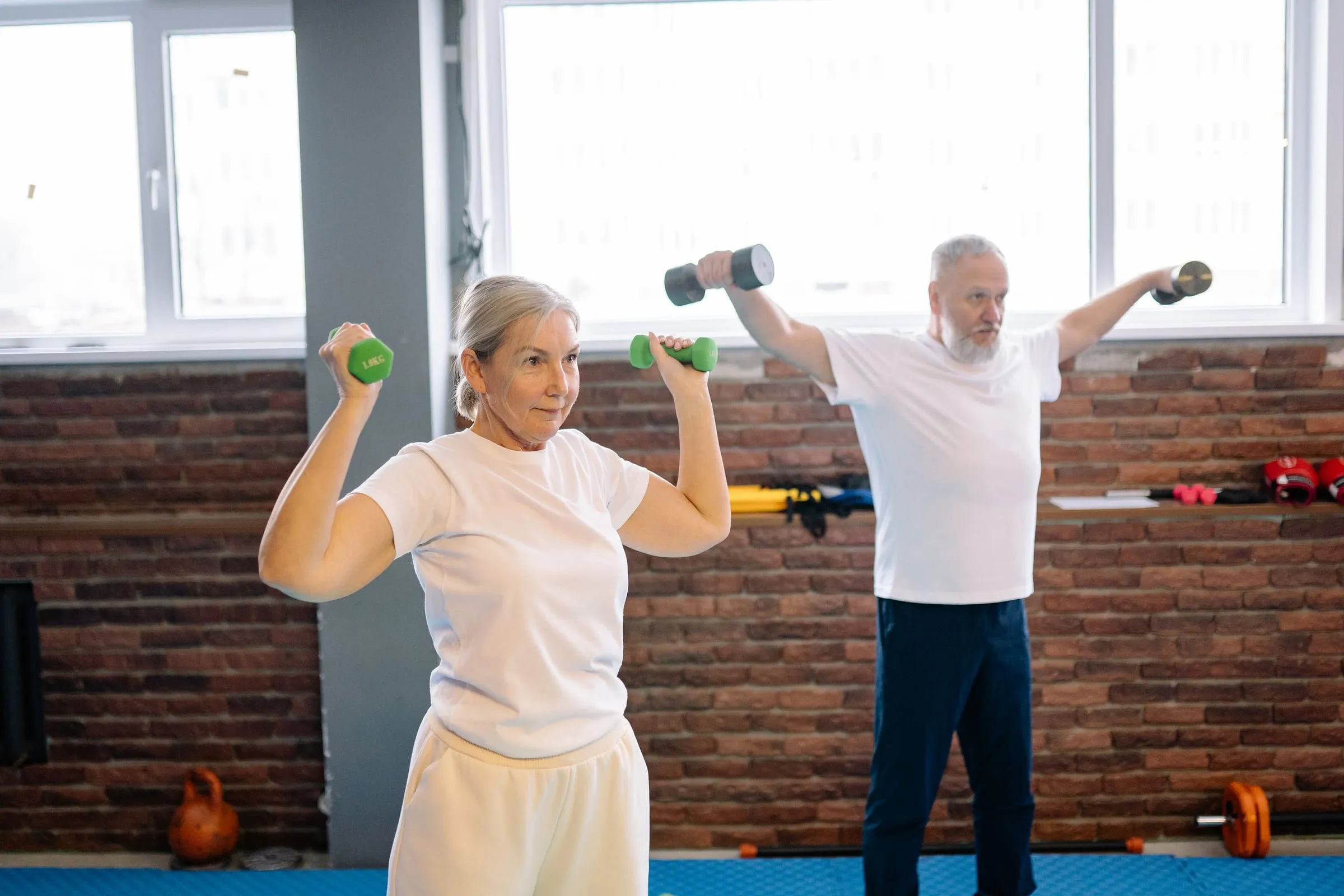
Power training means lifting as fast as you safely can, then lowering slowly under control. It targets the quality that fades fastest with age8,24.
In 20 trials in 566 healthy older adults (average age 70), power training improved physical function slightly more than traditional strength training (a standardized mean difference of 0.30), though certainty was low because the trials were small and at risk of bias32. Another meta-analysis of 15 trials found clear gains in muscle power and smaller advantages on everyday tests, especially speed-based ones33. The ACSM overview also found that fast-lifting power training enhanced physical function, and that power gains were enhanced by moderate loads (30% to 70% of maximum) and low-to-moderate volumes of 24 or fewer total reps25.
Adverse events were rare (about 3 per 1,000 sessions, versus 2 with traditional training), mostly arthritis flare-ups and soreness, and none were serious32. ICFSR flags strain on tendons and cartilage at the shoulder and knee, and hernia flare-ups, as the risks to watch24.
How to add power safely:
- Start with body weight: stand up from a chair as quickly as you safely can and sit down slowly, with hand support at first24.
- Then add a light load: about 40% to 60% of your maximum, light enough to move fast24.
- Keep sets short: stop while the reps are still fast, and never go to failure24.
- Do it early in the session, and go back to slow lifting if a knee or shoulder flares.
How do you train your balance?
Balance improves with practice that genuinely challenges it, a few times a week, somewhere a fall cannot hurt you15,24. The ICFSR rule is to practice the hardest position you can hold without falling, then progress by changing one thing at a time24:
- Narrow your base: feet apart holding a counter, then feet together, heel to toe, one foot, and one foot without hands.
- Reduce your senses: close your eyes or stand on a cushion.
- Shift your center of mass: reach, lean or hold a weight out to one side.
- Add a second task: count backward while you balance.
The WHO suggests walking backward or sideways, or standing on one foot during an upper-body exercise22, and tai chi has evidence too15. The 2022 World Falls Guidelines recommend balance-challenging and functional exercise, such as sit-to-stand and stepping practice, at least 3 times a week, progressed for at least 12 weeks and then continued, with resistance training and tai chi added where feasible34. Ten minutes at the kitchen counter counts. Clear the floor and keep a counter or sturdy chair within reach.
Machines, free weights, bands or bodyweight: which is best?
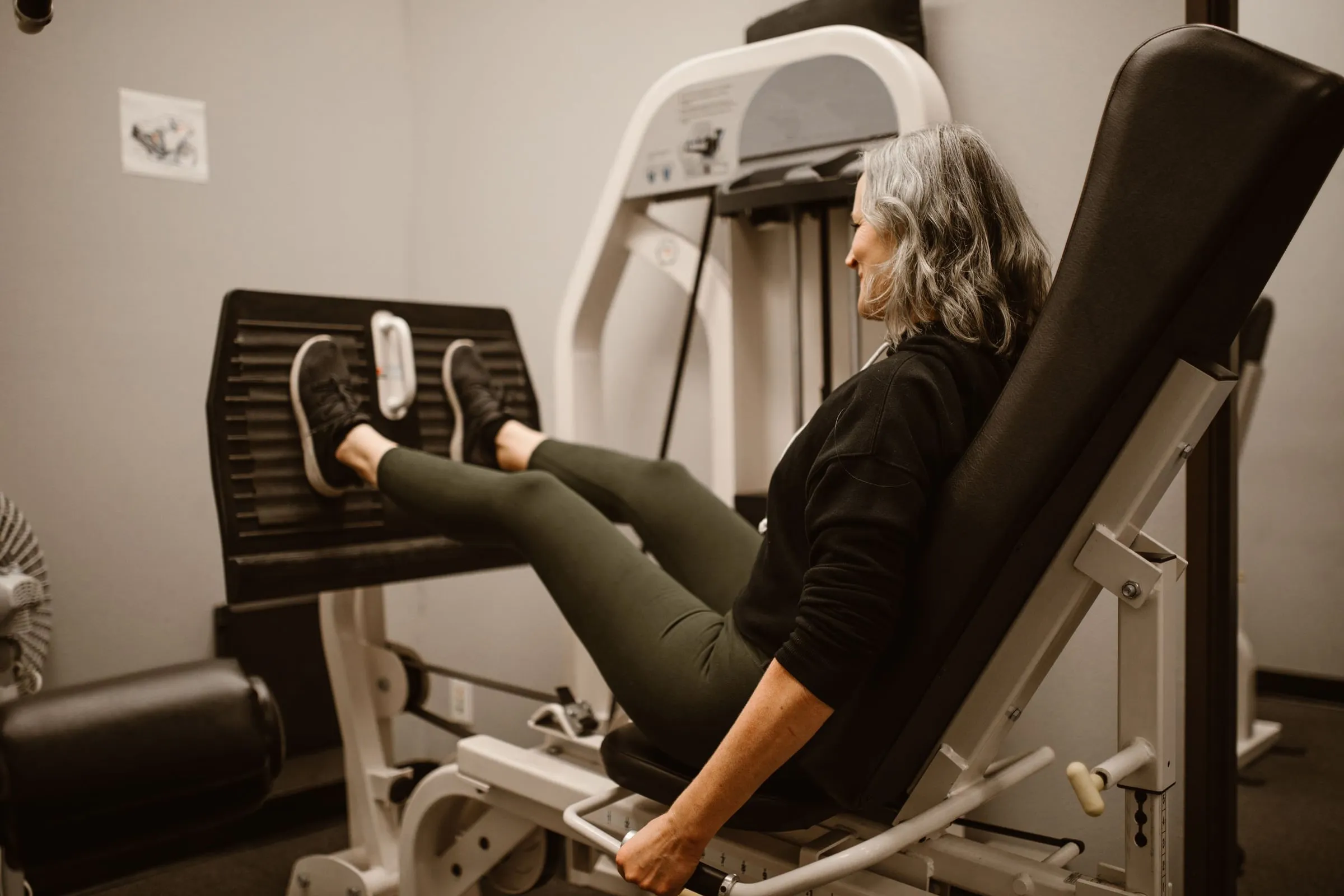
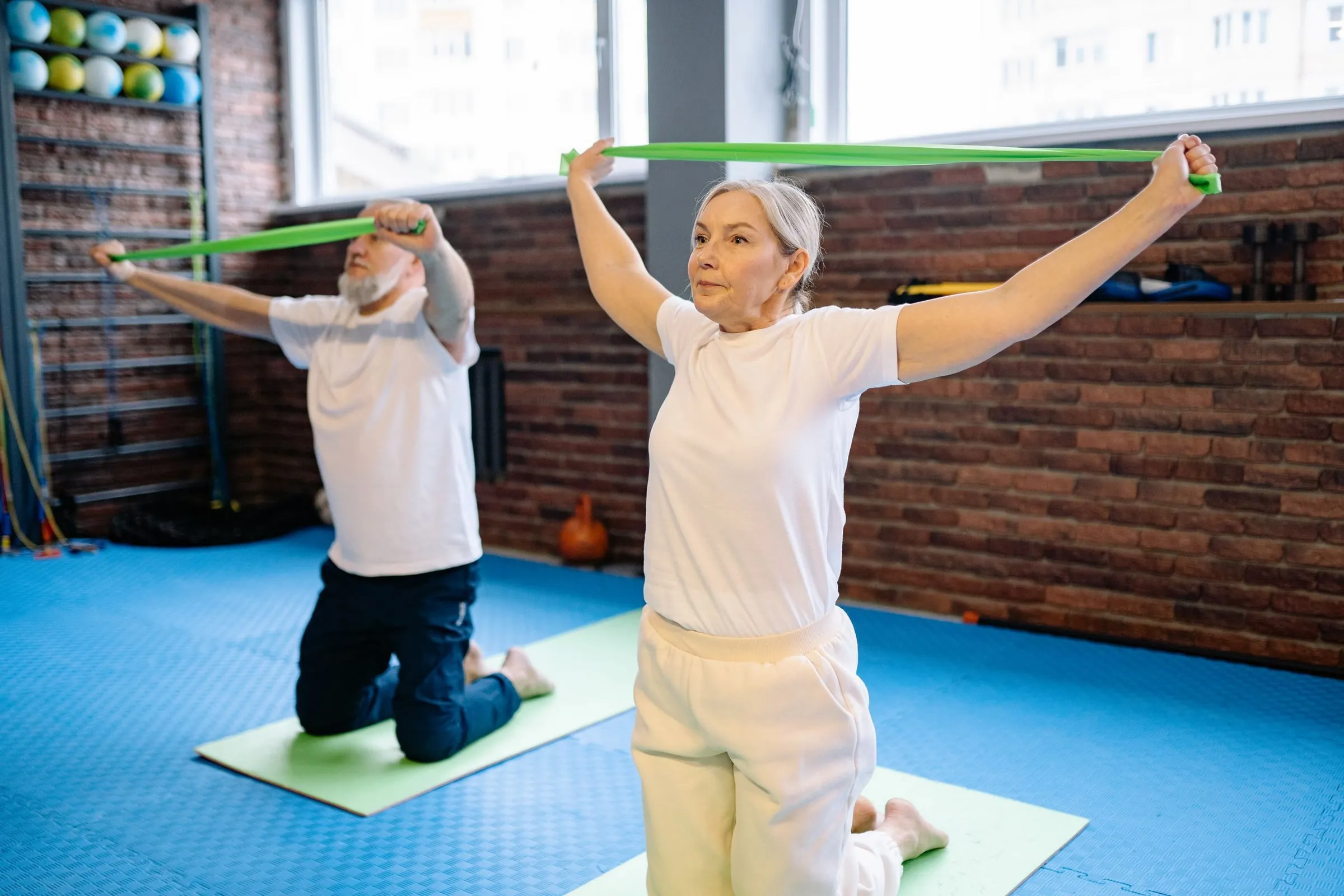
All of them work, and the best is the one you will keep using35. In a 2025 network meta-analysis of 102 trials in 4,754 community-dwelling older adults (average age 70), every format beat no training, machines most consistently, and the authors advise choosing by preference, enjoyment and practicality35. In the ACSM overview of healthy adults, equipment type did not consistently change results25.
| Option | Strength effect vs no training (standardized mean difference; above 0.8 is large) | Strengths | Watch for |
|---|---|---|---|
| Machines | 1.34 | Guided path, seat support, small weight steps | Needs a gym; fixed path may not suit every body |
| Free weights | 1.15 | Cheap, versatile, also trains balance | More technique to learn, ideally with a coach |
| Elastic bands | 0.93 | Cheap, portable, good for home | Resistance is hard to measure and progress |
| Bodyweight | 0.71 | No equipment: chair rises, wall push-ups, step-ups | Hard to make heavy enough as you get stronger |
Should you train with supervision or at home?
Supervision gives better results, but home training is far better than none36,37. Across 11 trials in healthy adults 65 and over, supervised programs improved strength and power more than fully unsupervised ones, and the authors suggest supervising about 2 of every 3 sessions36. The home-based Otago strength and balance program cut fall rates by 32% in people averaging 82, but after a year only 37% were still exercising 3 or more times a week37.
A good pattern is to learn the movements with a physical therapist, qualified trainer or class, then train at home or in a gym with regular check-ins. People with disabilities may need closer supervision, and for someone with cognitive impairment a trainer can judge effort from breathing, ability to talk and facial expression24. For home training a structured plan helps; the best workout apps for older adults compares tools that build one, including some offered free through health plans.
How much protein do you need after 60?
More than younger adults: at least 1.0 to 1.2 g per kilogram of body weight a day, at least 1.2 g/kg if you exercise, ideally as roughly 25 to 40 g per main meal38,12.
The PROT-AGE group recommends at least 1.0 to 1.2 g/kg a day after 65, at least 1.2 g/kg if you are active, and 1.2 to 1.5 g/kg for most people with acute or chronic illness38. The per-meal figure scales the lab finding above, about 0.4 g/kg a meal, to body weight12:
| Body weight | Daily target at 1.2 g/kg | Per meal at 0.4 g/kg |
|---|---|---|
| 60 kg (132 lb) | 72 g | 24 g |
| 70 kg (154 lb) | 84 g | 28 g |
| 85 kg (187 lb) | 102 g | 34 g |
| 100 kg (220 lb) | 120 g | 40 g |
Protein supports training but cannot replace it. In the 1994 nursing-home trial, a supplement without exercise did nothing for strength or frailty1, while in people with sarcopenia, adding nutrition to resistance and balance training gave the largest grip-strength gain, about 4 kg14. People with severe kidney disease (eGFR below 30) who are not on dialysis may need to limit protein and should agree a target with their doctor38. Food sources and timing are covered in how much protein you need to build muscle, and supplements in what creatine does and who should take it.
Is strength training safe after 60?
For most people, yes: serious adverse events are rare in trials, and sore muscles and achy joints are the usual problems3,15. In the Cochrane review, reporting was patchy, but no serious event was directly attributed to training, and people with osteoarthritis reported less pain afterward3. Trials in people over 75 recorded few adverse events2. For a painful joint or old injury, see training around injury.
What happens to blood pressure when you lift?
It rises sharply during a hard lift and falls as the effort eases, most of all near failure and when you hold your breath. In 5 young bodybuilders with pressure measured in an artery, leg presses to failure drove average peaks to 320/250 mm Hg; pressure rose with each lift, fell with each lowering, and was partly driven by straining against a closed throat, the Valsalva maneuver39. In 31 healthy men, the rise tracked effort rather than weight, and a brief Valsalva became unavoidable above about 80% of maximal effort31.
These were young men lifting maximally, but the lessons hold: breathe out as you lift, do not hold your breath, and stop a rep or two short of failure. Over months, resting blood pressure goes down: across 270 trials, dynamic resistance training lowered it by about 4.6/3.0 mm Hg, and isometric exercise such as wall squats by about 8.2/4.0 mm Hg40.
What should you avoid with osteoporosis?
Avoid loading the spine while it bends forward; otherwise, train. An international panel strongly recommends resistance and balance training for people with osteoporosis or spinal fractures, rather than aerobic exercise alone41. Exercise and Sports Science Australia advises against loaded spinal flexion, such as weighted sit-ups or lifting with a rounded back, and suggests modifying impact work for osteoarthritis or frailty42. Heavy lifting like LIFTMOR’s was safe under close supervision in screened women18; build up to it with a qualified coach.
Who should check with a doctor first?
ACSM’s screening rests on 3 questions: how active you are now, whether you have symptoms or known heart, metabolic or kidney disease, and how hard you plan to exercise. Exercise-related heart events are often preceded by warning signs, so the symptoms below matter43.
What does a beginner session look like?
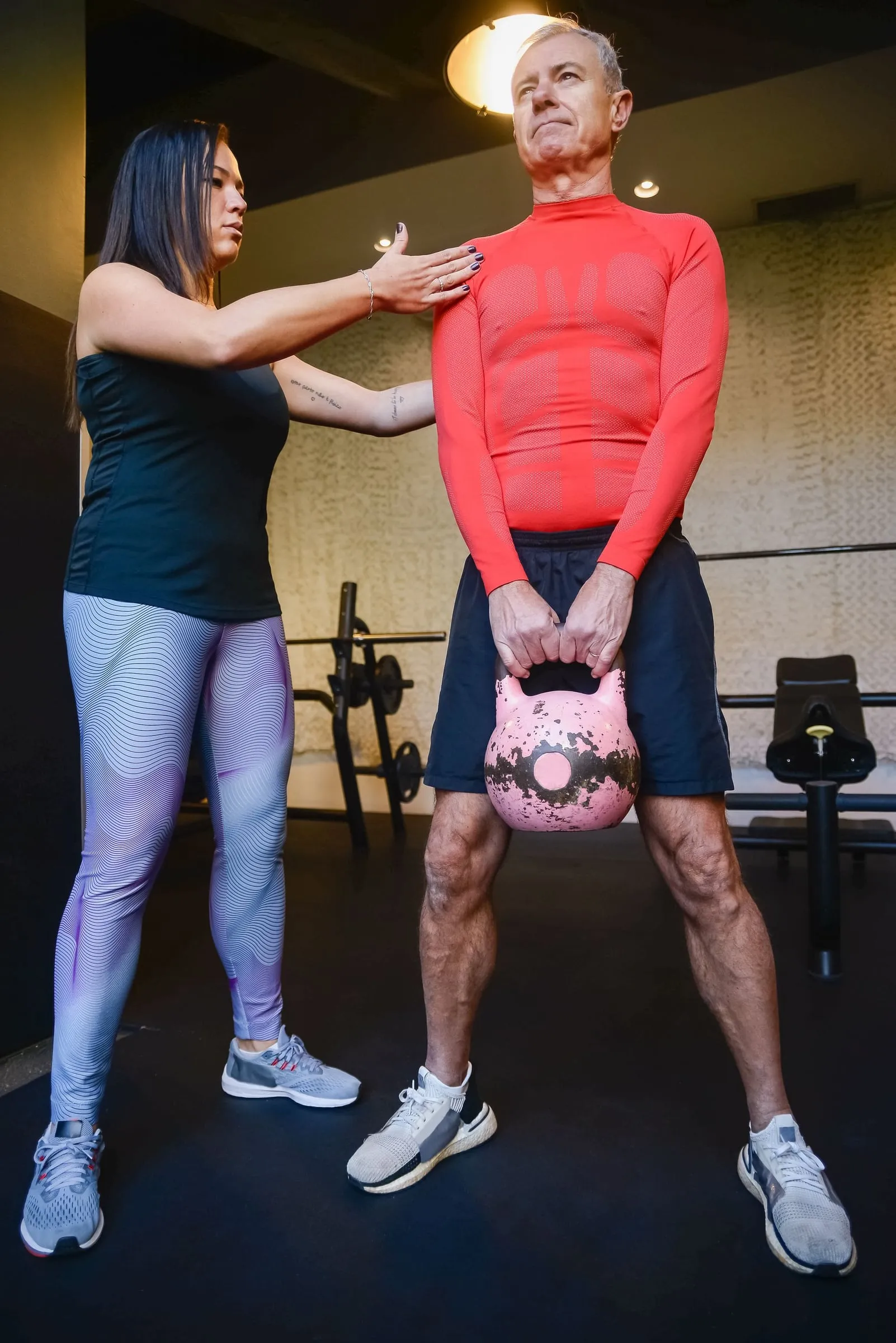
Here is a twice-weekly, full-body starting point to adapt with your doctor, physical therapist or trainer; it is not a prescription. It follows the ICFSR ranges: 1 to 2 sets at first, building to 2 to 3 sets of 8 to 12 reps, with 1 to 3 minutes’ rest between sets24. New to lifting? How to start strength training covers the first weeks.
Warm-up: 5 minutes of easy walking or marching in place, then 1 light set of the first 2 exercises.
Effort: strength sets end with 1 to 3 good reps left; power reps stay fast; balance work is challenging but safe.
| Exercise | Sets × reps | Easier option | Harder option |
|---|---|---|---|
| Sit-to-stand, fast up and slow down (power) | 2 × 5 to 8 | Higher seat; push off with hands | Lower seat; hold a dumbbell at your chest |
| Wall or counter push-up | 1 to 2 × 8 to 12 | Hands higher, feet closer | Lower surface, or a chest-press machine |
| Seated row (band, cable or machine) | 1 to 2 × 8 to 12 | Lighter band | Heavier band or machine; single-arm dumbbell row |
| Kettlebell or dumbbell deadlift from a raised block | 1 to 2 × 8 to 12 | Glute bridge on a bed or the floor | Lower starting height; heavier weight |
| Step-up holding a rail | 1 to 2 × 6 to 10 each leg | Lower step, both hands on the rail | Higher step; hold dumbbells |
| Seated dumbbell shoulder press | 1 to 2 × 8 to 12 | One arm at a time | Standing; heavier weight |
| Single-leg stand beside a counter | 2 to 3 × up to 30 seconds each leg | Heel-to-toe stance, fingertips on the counter | No hands, then eyes closed with the counter in reach |
How to run it:
- Weeks 1 to 2: 1 set of each at an easy-to-moderate effort (4 or more reps left), to learn the movements and find starting weights.
- Weeks 3 to 8: 2 sets at a hard effort. Use double progression: when you reach 12 reps on every set with 1 or 2 to spare, move to the next weight and drop back to 8 reps.
- After week 8: up to 3 sets on your priority exercises, faster power reps and harder balance work.
- Other days: balance practice on at least 3 days a week, and walking that builds toward 150 minutes a week22,34.
How can family members and caregivers help?
Make starting easy and keeping going normal, and frame strength as protecting independence, not fighting age.
- Lead with what they want to keep doing, such as gardening, travel or getting up off the floor.
- Ask for a falls assessment after a fall. The World Falls Guidelines say every older adult should get advice on preventing falls, and those at high risk a full, multifactorial assessment34.
- Book supervised sessions at the start with a physical therapist, qualified trainer or class36.
- Do not wait for frailty to improve. ICFSR calls frailty one of the most important reasons to prescribe exercise, not a reason to avoid it24.
- Restart soon after illness or a hospital stay, once the care team agrees. In 11 healthy adults aged about 67, 10 days of bed rest cost 13% of knee extensor strength and 14% of stair-climbing power44.
- Help make it a habit. In older adults, muscle gained through training had not significantly declined after 12 to 24 weeks off, but it had after 31 to 52 weeks45.
Questions people ask
- Is it too late to build muscle at 70 or 80?
- No. A meta-analysis of 22 randomized trials in adults aged 75 and older found clear strength gains, including in people over 80, plus smaller but real gains in muscle size. In a landmark trial, frail nursing-home residents averaging 87 years old more than doubled their strength in 10 weeks. Muscle grows less than in younger adults, so stronger legs and easier daily tasks are the main prize.
- How often should someone over 60 lift weights?
- Twice a week is enough to start and to make large gains. In a 24-week trial in adults aged 65 to 79, training 1, 2 or 3 days a week produced similar strength gains of about 37% to 42%. Pooled data suggest extra sessions add little. Add short balance practice on at least 3 days a week, and keep walking or doing other aerobic activity.
- Is weight training safe if I have high blood pressure?
- Usually, once your blood pressure is under control and your doctor agrees. Pressure spikes during hard lifts, most when you hold your breath or push to failure, so breathe out as you lift and stop a rep or two short. Over months, resistance training lowers resting blood pressure by about 4.6/3.0 mm Hg on average. Uncontrolled high blood pressure needs a medical review first.
- Can I lift weights if I have osteoporosis?
- Yes, and guidelines recommend resistance and balance training for people with osteoporosis. In the LIFTMOR trial, women around 65 with low bone mass who lifted heavy weights twice a week under close supervision gained spine bone density and held hip density steady, with one minor back spasm reported. Avoid loaded forward bending of the spine, and start with supervision if you have had a spinal fracture.
- Should older adults lift heavy or light weights?
- Both work. In a meta-analysis of 15 trials in adults averaging 68, heavy loads (about 80% of maximum) tended to build slightly more strength than lighter loads (about 45%), but lighter loads still produced substantial gains when people did enough reps. Start light to learn each movement, then progress to weights you can lift 8 to 12 times with 1 to 3 reps to spare.
- Do I need a gym, or can I strength train at home?
- You can start at home. A network meta-analysis of 102 trials found machines, free weights, elastic bands and bodyweight exercises all improved strength in older adults, with machines giving the largest and most consistent gains. The home-based Otago program cut falls by 32% in people averaging 82. Supervised sessions add more, so consider learning the movements with a professional first.
- How much protein do older adults need?
- More than younger adults. Expert groups recommend at least 1.0 to 1.2 g per kilogram of body weight a day after 65, at least 1.2 g/kg if you exercise, and 1.2 to 1.5 g/kg for most people with acute or chronic illness. Aim for roughly 25 to 40 g at each main meal. If you have severe kidney disease, agree a target with your doctor.
- How can I help a parent start strength training?
- Frame it around what they want to keep doing, not around age. Ask their doctor for a check-up and, if they have fallen, a falls risk assessment. A few supervised sessions with a physical therapist or qualified trainer help them learn safely, then home practice fills the gaps. Frailty is not a reason to wait: frail nursing-home residents have more than doubled their strength in trials.
References
- 1Randomized trialFiatarone MA, O'Neill EF, Ryan ND, Clements KM, Solares GR, Nelson ME, Roberts SB, Kehayias JJ, Lipsitz LA, Evans WJ (1994). Exercise training and nutritional supplementation for physical frailty in very elderly people. New England Journal of Medicine, 330(25), 1769-75DOIPubMedFiatarone MA, O'Neill EF, Ryan ND, Clements KM, Solares GR, Nelson ME, Roberts SB, Kehayias JJ, Lipsitz LA, Evans WJ. Exercise training and nutritional supplementation for physical frailty in very elderly people. New England Journal of Medicine. 1994;330(25):1769-75. doi:10.1056/NEJM199406233302501 PMID: 8190152
- 2Meta-analysisGrgic J, Garofolini A, Orazem J, Sabol F, Schoenfeld BJ, Pedisic Z (2020). Effects of Resistance Training on Muscle Size and Strength in Very Elderly Adults: A Systematic Review and Meta-Analysis of Randomized Controlled Trials. Sports Medicine, 50(11), 1983-1999DOIPubMedGrgic J, Garofolini A, Orazem J, Sabol F, Schoenfeld BJ, Pedisic Z. Effects of Resistance Training on Muscle Size and Strength in Very Elderly Adults: A Systematic Review and Meta-Analysis of Randomized Controlled Trials. Sports Medicine. 2020;50(11):1983-1999. doi:10.1007/s40279-020-01331-7 PMID: 32740889
- 3Systematic reviewLiu CJ, Latham NK (2009). Progressive resistance strength training for improving physical function in older adults. Cochrane Database of Systematic Reviews, 2009(3), CD002759DOIPubMedLiu CJ, Latham NK. Progressive resistance strength training for improving physical function in older adults. Cochrane Database of Systematic Reviews. 2009;2009(3):CD002759. doi:10.1002/14651858.CD002759.pub2 PMID: 19588334
- 4SourceFiatarone MA, Marks EC, Ryan ND, Meredith CN, Lipsitz LA, Evans WJ (1990). High-intensity strength training in nonagenarians. Effects on skeletal muscle. JAMA, 263(22), 3029-34DOIPubMedFiatarone MA, Marks EC, Ryan ND, Meredith CN, Lipsitz LA, Evans WJ. High-intensity strength training in nonagenarians. Effects on skeletal muscle. JAMA. 1990;263(22):3029-34. doi:10.1001/jama.1990.03440220053029 PMID: 2342214
- 5Meta-analysisPeterson MD, Rhea MR, Sen A, Gordon PM (2010). Resistance exercise for muscular strength in older adults: a meta-analysis. Ageing Research Reviews, 9(3), 226-37DOIPubMedPeterson MD, Rhea MR, Sen A, Gordon PM. Resistance exercise for muscular strength in older adults: a meta-analysis. Ageing Research Reviews. 2010;9(3):226-37. doi:10.1016/j.arr.2010.03.004 PMID: 20385254
- 6Meta-analysisPeterson MD, Sen A, Gordon PM (2011). Influence of resistance exercise on lean body mass in aging adults: a meta-analysis. Medicine and Science in Sports and Exercise, 43(2), 249-58DOIPubMedPeterson MD, Sen A, Gordon PM. Influence of resistance exercise on lean body mass in aging adults: a meta-analysis. Medicine and Science in Sports and Exercise. 2011;43(2):249-58. doi:10.1249/MSS.0b013e3181eb6265 PMID: 20543750
- 7Narrative reviewMitchell WK, Williams J, Atherton P, Larvin M, Lund J, Narici M (2012). Sarcopenia, dynapenia, and the impact of advancing age on human skeletal muscle size and strength; a quantitative review. Frontiers in Physiology, 3, 260DOIPubMedMitchell WK, Williams J, Atherton P, Larvin M, Lund J, Narici M. Sarcopenia, dynapenia, and the impact of advancing age on human skeletal muscle size and strength; a quantitative review. Frontiers in Physiology. 2012;3:260. doi:10.3389/fphys.2012.00260 PMID: 22934016
- 8Cross-sectional studySkelton DA, Greig CA, Davies JM, Young A (1994). Strength, power and related functional ability of healthy people aged 65-89 years. Age and Ageing, 23(5), 371-7DOIPubMedSkelton DA, Greig CA, Davies JM, Young A. Strength, power and related functional ability of healthy people aged 65-89 years. Age and Ageing. 1994;23(5):371-7. doi:10.1093/ageing/23.5.371 PMID: 7825481
- 9Consensus statementCruz-Jentoft AJ, Bahat G, Bauer J, Boirie Y, Bruyère O, Cederholm T, et al. (2019). Sarcopenia: revised European consensus on definition and diagnosis. Age and Ageing, 48(1), 16-31DOIPubMedCruz-Jentoft AJ, Bahat G, Bauer J, Boirie Y, Bruyère O, Cederholm T, et al.. Sarcopenia: revised European consensus on definition and diagnosis. Age and Ageing. 2019;48(1):16-31. doi:10.1093/ageing/afy169 PMID: 30312372
- 10Cohort studyGoodpaster BH, Park SW, Harris TB, Kritchevsky SB, Nevitt M, Schwartz AV, Simonsick EM, Tylavsky FA, Visser M, Newman AB (2006). The loss of skeletal muscle strength, mass, and quality in older adults: the health, aging and body composition study. Journals of Gerontology, Series A: Biological Sciences and Medical Sciences, 61(10), 1059-64DOIPubMedGoodpaster BH, Park SW, Harris TB, Kritchevsky SB, Nevitt M, Schwartz AV, Simonsick EM, Tylavsky FA, Visser M, Newman AB. The loss of skeletal muscle strength, mass, and quality in older adults: the health, aging and body composition study. Journals of Gerontology, Series A: Biological Sciences and Medical Sciences. 2006;61(10):1059-64. doi:10.1093/gerona/61.10.1059 PMID: 17077199
- 11Mechanistic studyKumar V, Selby A, Rankin D, Patel R, Atherton P, Hildebrandt W, Williams J, Smith K, Seynnes O, Hiscock N, Rennie MJ (2009). Age-related differences in the dose-response relationship of muscle protein synthesis to resistance exercise in young and old men. The Journal of Physiology, 587(1), 211-7DOIPubMedKumar V, Selby A, Rankin D, Patel R, Atherton P, Hildebrandt W, Williams J, Smith K, Seynnes O, Hiscock N, Rennie MJ. Age-related differences in the dose-response relationship of muscle protein synthesis to resistance exercise in young and old men. The Journal of Physiology. 2009;587(1):211-7. doi:10.1113/jphysiol.2008.164483 PMID: 19001042
- 12Mechanistic studyMoore DR, Churchward-Venne TA, Witard O, Breen L, Burd NA, Tipton KD, Phillips SM (2015). Protein ingestion to stimulate myofibrillar protein synthesis requires greater relative protein intakes in healthy older versus younger men. Journals of Gerontology, Series A: Biological Sciences and Medical Sciences, 70(1), 57-62DOIPubMedMoore DR, Churchward-Venne TA, Witard O, Breen L, Burd NA, Tipton KD, Phillips SM. Protein ingestion to stimulate myofibrillar protein synthesis requires greater relative protein intakes in healthy older versus younger men. Journals of Gerontology, Series A: Biological Sciences and Medical Sciences. 2015;70(1):57-62. doi:10.1093/gerona/glu103 PMID: 25056502
- 13Mechanistic studyPennings B, Koopman R, Beelen M, Senden JM, Saris WH, van Loon LJ (2011). Exercising before protein intake allows for greater use of dietary protein-derived amino acids for de novo muscle protein synthesis in both young and elderly men. The American Journal of Clinical Nutrition, 93(2), 322-31DOIPubMedPennings B, Koopman R, Beelen M, Senden JM, Saris WH, van Loon LJ. Exercising before protein intake allows for greater use of dietary protein-derived amino acids for de novo muscle protein synthesis in both young and elderly men. The American Journal of Clinical Nutrition. 2011;93(2):322-31. doi:10.3945/ajcn.2010.29649 PMID: 21084649
- 14Meta-analysisShen Y, Shi Q, Nong K, Li S, Yue J, Huang J, Dong B, Beauchamp M, Hao Q (2023). Exercise for sarcopenia in older people: A systematic review and network meta-analysis. Journal of Cachexia, Sarcopenia and Muscle, 14(3), 1199-1211DOIPubMedShen Y, Shi Q, Nong K, Li S, Yue J, Huang J, Dong B, Beauchamp M, Hao Q. Exercise for sarcopenia in older people: A systematic review and network meta-analysis. Journal of Cachexia, Sarcopenia and Muscle. 2023;14(3):1199-1211. doi:10.1002/jcsm.13225 PMID: 37057640
- 15Systematic reviewSherrington C, Fairhall NJ, Wallbank GK, Tiedemann A, Michaleff ZA, Howard K, Clemson L, Hopewell S, Lamb SE (2019). Exercise for preventing falls in older people living in the community. Cochrane Database of Systematic Reviews, 1(1), CD012424DOIPubMedSherrington C, Fairhall NJ, Wallbank GK, Tiedemann A, Michaleff ZA, Howard K, Clemson L, Hopewell S, Lamb SE. Exercise for preventing falls in older people living in the community. Cochrane Database of Systematic Reviews. 2019;1(1):CD012424. doi:10.1002/14651858.CD012424.pub2 PMID: 30703272
- 16Meta-analysisEl-Khoury F, Cassou B, Charles MA, Dargent-Molina P (2013). The effect of fall prevention exercise programmes on fall induced injuries in community dwelling older adults: systematic review and meta-analysis of randomised controlled trials. BMJ, 347, f6234PubMedEl-Khoury F, Cassou B, Charles MA, Dargent-Molina P. The effect of fall prevention exercise programmes on fall induced injuries in community dwelling older adults: systematic review and meta-analysis of randomised controlled trials. BMJ. 2013;347:f6234. PMID: 24169944
- 17Meta-analysisShojaa M, Von Stengel S, Schoene D, Kohl M, Barone G, Bragonzoni L, et al. (2020). Effect of Exercise Training on Bone Mineral Density in Post-menopausal Women: A Systematic Review and Meta-Analysis of Intervention Studies. Frontiers in Physiology, 11, 652DOIPubMedShojaa M, Von Stengel S, Schoene D, Kohl M, Barone G, Bragonzoni L, et al.. Effect of Exercise Training on Bone Mineral Density in Post-menopausal Women: A Systematic Review and Meta-Analysis of Intervention Studies. Frontiers in Physiology. 2020;11:652. doi:10.3389/fphys.2020.00652 PMID: 32655410
- 18Randomized trialWatson SL, Weeks BK, Weis LJ, Harding AT, Horan SA, Beck BR (2018). High-Intensity Resistance and Impact Training Improves Bone Mineral Density and Physical Function in Postmenopausal Women With Osteopenia and Osteoporosis: The LIFTMOR Randomized Controlled Trial. Journal of Bone and Mineral Research, 33(2), 211-220DOIPubMedWatson SL, Weeks BK, Weis LJ, Harding AT, Horan SA, Beck BR. High-Intensity Resistance and Impact Training Improves Bone Mineral Density and Physical Function in Postmenopausal Women With Osteopenia and Osteoporosis: The LIFTMOR Randomized Controlled Trial. Journal of Bone and Mineral Research. 2018;33(2):211-220. doi:10.1002/jbmr.3284 PMID: 28975661
- 19Meta-analysisMomma H, Kawakami R, Honda T, Sawada SS (2022). Muscle-strengthening activities are associated with lower risk and mortality in major non-communicable diseases: a systematic review and meta-analysis of cohort studies. British Journal of Sports Medicine, 56(13), 755-763DOIPubMedMomma H, Kawakami R, Honda T, Sawada SS. Muscle-strengthening activities are associated with lower risk and mortality in major non-communicable diseases: a systematic review and meta-analysis of cohort studies. British Journal of Sports Medicine. 2022;56(13):755-763. doi:10.1136/bjsports-2021-105061 PMID: 35228201
- 20Cohort studyGorzelitz J, Trabert B, Katki HA, Moore SC, Watts EL, Matthews CE (2022). Independent and joint associations of weightlifting and aerobic activity with all-cause, cardiovascular disease and cancer mortality in the Prostate, Lung, Colorectal and Ovarian Cancer Screening Trial. British Journal of Sports Medicine, 56(22), 1277-1283DOIPubMedGorzelitz J, Trabert B, Katki HA, Moore SC, Watts EL, Matthews CE. Independent and joint associations of weightlifting and aerobic activity with all-cause, cardiovascular disease and cancer mortality in the Prostate, Lung, Colorectal and Ovarian Cancer Screening Trial. British Journal of Sports Medicine. 2022;56(22):1277-1283. doi:10.1136/bjsports-2021-105315 PMID: 36167669
- 21Cohort studyLeong DP, Teo KK, Rangarajan S, Lopez-Jaramillo P, Avezum A Jr, Orlandini A, et al. (2015). Prognostic value of grip strength: findings from the Prospective Urban Rural Epidemiology (PURE) study. The Lancet, 386(9990), 266-73DOIPubMedLeong DP, Teo KK, Rangarajan S, Lopez-Jaramillo P, Avezum A Jr, Orlandini A, et al.. Prognostic value of grip strength: findings from the Prospective Urban Rural Epidemiology (PURE) study. The Lancet. 2015;386(9990):266-73. doi:10.1016/S0140-6736(14)62000-6 PMID: 25982160
- 22GuidelineBull FC, Al-Ansari SS, Biddle S, Borodulin K, Buman MP, Cardon G, et al. (2020). World Health Organization 2020 guidelines on physical activity and sedentary behaviour. British Journal of Sports Medicine, 54(24), 1451-1462DOIPubMedBull FC, Al-Ansari SS, Biddle S, Borodulin K, Buman MP, Cardon G, et al.. World Health Organization 2020 guidelines on physical activity and sedentary behaviour. British Journal of Sports Medicine. 2020;54(24):1451-1462. doi:10.1136/bjsports-2020-102955 PMID: 33239350
- 23Position standChodzko-Zajko WJ, Proctor DN, Fiatarone Singh MA, Minson CT, Nigg CR, Salem GJ, Skinner JS (2009). American College of Sports Medicine position stand. Exercise and physical activity for older adults. Medicine and Science in Sports and Exercise, 41(7), 1510-30DOIChodzko-Zajko WJ, Proctor DN, Fiatarone Singh MA, Minson CT, Nigg CR, Salem GJ, Skinner JS. American College of Sports Medicine position stand. Exercise and physical activity for older adults. Medicine and Science in Sports and Exercise. 2009;41(7):1510-30. doi:10.1249/MSS.0b013e3181a0c95c
- 24Consensus statementIzquierdo M, Merchant RA, Morley JE, Anker SD, Aprahamian I, Arai H, et al. (2021). International Exercise Recommendations in Older Adults (ICFSR): Expert Consensus Guidelines. Journal of Nutrition, Health and Aging, 25(7), 824-853DOIPubMedIzquierdo M, Merchant RA, Morley JE, Anker SD, Aprahamian I, Arai H, et al.. International Exercise Recommendations in Older Adults (ICFSR): Expert Consensus Guidelines. Journal of Nutrition, Health and Aging. 2021;25(7):824-853. doi:10.1007/s12603-021-1665-8 PMID: 34409961
- 25Position standCurrier BS, D'Souza AC, Singh MAF, Lowisz CV, Rawson ES, Schoenfeld BJ, et al. (2026). American College of Sports Medicine Position Stand. Resistance Training Prescription for Muscle Function, Hypertrophy, and Physical Performance in Healthy Adults: An Overview of Reviews. Medicine and Science in Sports and Exercise, 58(4), 851-872DOIPubMedCurrier BS, D'Souza AC, Singh MAF, Lowisz CV, Rawson ES, Schoenfeld BJ, et al.. American College of Sports Medicine Position Stand. Resistance Training Prescription for Muscle Function, Hypertrophy, and Physical Performance in Healthy Adults: An Overview of Reviews. Medicine and Science in Sports and Exercise. 2026;58(4):851-872. doi:10.1249/MSS.0000000000003897 PMID: 41843416
- 26Meta-analysisBorde R, Hortobágyi T, Granacher U (2015). Dose-Response Relationships of Resistance Training in Healthy Old Adults: A Systematic Review and Meta-Analysis. Sports Medicine, 45(12), 1693-720DOIPubMedBorde R, Hortobágyi T, Granacher U. Dose-Response Relationships of Resistance Training in Healthy Old Adults: A Systematic Review and Meta-Analysis. Sports Medicine. 2015;45(12):1693-720. doi:10.1007/s40279-015-0385-9 PMID: 26420238
- 27Randomized trialTaaffe DR, Duret C, Wheeler S, Marcus R (1999). Once-weekly resistance exercise improves muscle strength and neuromuscular performance in older adults. Journal of the American Geriatrics Society, 47(10), 1208-14DOIPubMedTaaffe DR, Duret C, Wheeler S, Marcus R. Once-weekly resistance exercise improves muscle strength and neuromuscular performance in older adults. Journal of the American Geriatrics Society. 1999;47(10):1208-14. doi:10.1111/j.1532-5415.1999.tb05201.x PMID: 10522954
- 28Meta-analysisKneffel Z, Murlasits Z, Reed J, Krieger J (2021). A meta-regression of the effects of resistance training frequency on muscular strength and hypertrophy in adults over 60 years of age. Journal of Sports Sciences, 39(3), 351-358DOIPubMedKneffel Z, Murlasits Z, Reed J, Krieger J. A meta-regression of the effects of resistance training frequency on muscular strength and hypertrophy in adults over 60 years of age. Journal of Sports Sciences. 2021;39(3):351-358. doi:10.1080/02640414.2020.1822595 PMID: 32948100
- 29Randomized trialGalvão DA, Taaffe DR (2005). Resistance exercise dosage in older adults: single- versus multiset effects on physical performance and body composition. Journal of the American Geriatrics Society, 53(12), 2090-7DOIPubMedGalvão DA, Taaffe DR. Resistance exercise dosage in older adults: single- versus multiset effects on physical performance and body composition. Journal of the American Geriatrics Society. 2005;53(12):2090-7. doi:10.1111/j.1532-5415.2005.00494.x PMID: 16398892
- 30Meta-analysisCsapo R, Alegre LM (2016). Effects of resistance training with moderate vs heavy loads on muscle mass and strength in the elderly: A meta-analysis. Scandinavian Journal of Medicine and Science in Sports, 26(9), 995-1006DOIPubMedCsapo R, Alegre LM. Effects of resistance training with moderate vs heavy loads on muscle mass and strength in the elderly: A meta-analysis. Scandinavian Journal of Medicine and Science in Sports. 2016;26(9):995-1006. doi:10.1111/sms.12536 PMID: 26302881
- 31Mechanistic studyMacDougall JD, McKelvie RS, Moroz DE, Sale DG, McCartney N, Buick F (1992). Factors affecting blood pressure during heavy weight lifting and static contractions. Journal of Applied Physiology, 73(4), 1590-7DOIPubMedMacDougall JD, McKelvie RS, Moroz DE, Sale DG, McCartney N, Buick F. Factors affecting blood pressure during heavy weight lifting and static contractions. Journal of Applied Physiology. 1992;73(4):1590-7. doi:10.1152/jappl.1992.73.4.1590 PMID: 1447109
- 32Meta-analysisBalachandran AT, Steele J, Angielczyk D, Belio M, Schoenfeld BJ, Quiles N, Askin N, Abou-Setta AM (2022). Comparison of Power Training vs Traditional Strength Training on Physical Function in Older Adults: A Systematic Review and Meta-analysis. JAMA Network Open, 5(5), e2211623DOIPubMedBalachandran AT, Steele J, Angielczyk D, Belio M, Schoenfeld BJ, Quiles N, Askin N, Abou-Setta AM. Comparison of Power Training vs Traditional Strength Training on Physical Function in Older Adults: A Systematic Review and Meta-analysis. JAMA Network Open. 2022;5(5):e2211623. doi:10.1001/jamanetworkopen.2022.11623 PMID: 35544136
- 33Meta-analysisEl Hadouchi M, Kiers H, de Vries R, Veenhof C, van Dieën J (2022). Effectiveness of power training compared to strength training in older adults: a systematic review and meta-analysis. European Review of Aging and Physical Activity, 19(1), 18DOIPubMedEl Hadouchi M, Kiers H, de Vries R, Veenhof C, van Dieën J. Effectiveness of power training compared to strength training in older adults: a systematic review and meta-analysis. European Review of Aging and Physical Activity. 2022;19(1):18. doi:10.1186/s11556-022-00297-x PMID: 35953775
- 34GuidelineMontero-Odasso M, van der Velde N, Martin FC, Petrovic M, Tan MP, Ryg J, et al. (2022). World guidelines for falls prevention and management for older adults: a global initiative. Age and Ageing, 51(9), afac205DOIPubMedMontero-Odasso M, van der Velde N, Martin FC, Petrovic M, Tan MP, Ryg J, et al.. World guidelines for falls prevention and management for older adults: a global initiative. Age and Ageing. 2022;51(9):afac205. doi:10.1093/ageing/afac205 PMID: 36178003
- 35Meta-analysisWiedenmann T, Held S, Morat T, Rappelt L, Isenmann E, Berndsen E, Hopp NH, Donath L (2025). The Effects of Different Resistance Training Modalities on Muscle Strength in Community-Dwelling Older Adults: A Network Meta-Analysis. Gerontology, 71(7), 576-588DOIPubMedWiedenmann T, Held S, Morat T, Rappelt L, Isenmann E, Berndsen E, Hopp NH, Donath L. The Effects of Different Resistance Training Modalities on Muscle Strength in Community-Dwelling Older Adults: A Network Meta-Analysis. Gerontology. 2025;71(7):576-588. doi:10.1159/000546346 PMID: 40452461
- 36Meta-analysisLacroix A, Hortobágyi T, Beurskens R, Granacher U (2017). Effects of Supervised vs. Unsupervised Training Programs on Balance and Muscle Strength in Older Adults: A Systematic Review and Meta-Analysis. Sports Medicine, 47(11), 2341-2361DOIPubMedLacroix A, Hortobágyi T, Beurskens R, Granacher U. Effects of Supervised vs. Unsupervised Training Programs on Balance and Muscle Strength in Older Adults: A Systematic Review and Meta-Analysis. Sports Medicine. 2017;47(11):2341-2361. doi:10.1007/s40279-017-0747-6 PMID: 28573401
- 37Meta-analysisThomas S, Mackintosh S, Halbert J (2010). Does the 'Otago exercise programme' reduce mortality and falls in older adults?: a systematic review and meta-analysis. Age and Ageing, 39(6), 681-7DOIPubMedThomas S, Mackintosh S, Halbert J. Does the 'Otago exercise programme' reduce mortality and falls in older adults?: a systematic review and meta-analysis. Age and Ageing. 2010;39(6):681-7. doi:10.1093/ageing/afq102 PMID: 20817938
- 38Position standBauer J, Biolo G, Cederholm T, Cesari M, Cruz-Jentoft AJ, Morley JE, et al. (2013). Evidence-based recommendations for optimal dietary protein intake in older people: a position paper from the PROT-AGE Study Group. Journal of the American Medical Directors Association, 14(8), 542-59DOIPubMedBauer J, Biolo G, Cederholm T, Cesari M, Cruz-Jentoft AJ, Morley JE, et al.. Evidence-based recommendations for optimal dietary protein intake in older people: a position paper from the PROT-AGE Study Group. Journal of the American Medical Directors Association. 2013;14(8):542-59. doi:10.1016/j.jamda.2013.05.021 PMID: 23867520
- 39Mechanistic studyMacDougall JD, Tuxen D, Sale DG, Moroz JR, Sutton JR (1985). Arterial blood pressure response to heavy resistance exercise. Journal of Applied Physiology, 58(3), 785-90DOIPubMedMacDougall JD, Tuxen D, Sale DG, Moroz JR, Sutton JR. Arterial blood pressure response to heavy resistance exercise. Journal of Applied Physiology. 1985;58(3):785-90. doi:10.1152/jappl.1985.58.3.785 PMID: 3980383
- 40Meta-analysisEdwards JJ, Deenmamode AHP, Griffiths M, Arnold O, Cooper NJ, Wiles JD, O'Driscoll JM (2023). Exercise training and resting blood pressure: a large-scale pairwise and network meta-analysis of randomised controlled trials. British Journal of Sports Medicine, 57(20), 1317-1326DOIPubMedEdwards JJ, Deenmamode AHP, Griffiths M, Arnold O, Cooper NJ, Wiles JD, O'Driscoll JM. Exercise training and resting blood pressure: a large-scale pairwise and network meta-analysis of randomised controlled trials. British Journal of Sports Medicine. 2023;57(20):1317-1326. doi:10.1136/bjsports-2022-106503 PMID: 37491419
- 41Consensus statementGiangregorio LM, Papaioannou A, Macintyre NJ, Ashe MC, Heinonen A, Shipp K, Wark J, McGill S, Keller H, Jain R, Laprade J, Cheung AM (2014). Too Fit To Fracture: exercise recommendations for individuals with osteoporosis or osteoporotic vertebral fracture. Osteoporosis International, 25(3), 821-35DOIPubMedGiangregorio LM, Papaioannou A, Macintyre NJ, Ashe MC, Heinonen A, Shipp K, Wark J, McGill S, Keller H, Jain R, Laprade J, Cheung AM. Too Fit To Fracture: exercise recommendations for individuals with osteoporosis or osteoporotic vertebral fracture. Osteoporosis International. 2014;25(3):821-35. doi:10.1007/s00198-013-2523-2 PMID: 24281053
- 42Position standBeck BR, Daly RM, Singh MA, Taaffe DR (2017). Exercise and Sports Science Australia (ESSA) position statement on exercise prescription for the prevention and management of osteoporosis. Journal of Science and Medicine in Sport, 20(5), 438-445DOIPubMedBeck BR, Daly RM, Singh MA, Taaffe DR. Exercise and Sports Science Australia (ESSA) position statement on exercise prescription for the prevention and management of osteoporosis. Journal of Science and Medicine in Sport. 2017;20(5):438-445. doi:10.1016/j.jsams.2016.10.001 PMID: 27840033
- 43GuidelineRiebe D, Franklin BA, Thompson PD, Garber CE, Whitfield GP, Magal M, Pescatello LS (2015). Updating ACSM's Recommendations for Exercise Preparticipation Health Screening. Medicine and Science in Sports and Exercise, 47(11), 2473-9DOIPubMedRiebe D, Franklin BA, Thompson PD, Garber CE, Whitfield GP, Magal M, Pescatello LS. Updating ACSM's Recommendations for Exercise Preparticipation Health Screening. Medicine and Science in Sports and Exercise. 2015;47(11):2473-9. doi:10.1249/MSS.0000000000000664 PMID: 26473759
- 44SourceKortebein P, Symons TB, Ferrando A, Paddon-Jones D, Ronsen O, Protas E, Conger S, Lombeida J, Wolfe R, Evans WJ (2008). Functional impact of 10 days of bed rest in healthy older adults. Journals of Gerontology, Series A: Biological Sciences and Medical Sciences, 63(10), 1076-81DOIPubMedKortebein P, Symons TB, Ferrando A, Paddon-Jones D, Ronsen O, Protas E, Conger S, Lombeida J, Wolfe R, Evans WJ. Functional impact of 10 days of bed rest in healthy older adults. Journals of Gerontology, Series A: Biological Sciences and Medical Sciences. 2008;63(10):1076-81. doi:10.1093/gerona/63.10.1076 PMID: 18948558
- 45Meta-analysisGrgic J (2022). Use It or Lose It? A Meta-Analysis on the Effects of Resistance Training Cessation (Detraining) on Muscle Size in Older Adults. International Journal of Environmental Research and Public Health, 19(21), 14048DOIPubMedGrgic J. Use It or Lose It? A Meta-Analysis on the Effects of Resistance Training Cessation (Detraining) on Muscle Size in Older Adults. International Journal of Environmental Research and Public Health. 2022;19(21):14048. doi:10.3390/ijerph192114048 PMID: 36360927
Read next
Muscle Growth · Guide
How muscles grow: the science of hypertrophy, and how to train for it
Muscle doesn't grow by tearing and healing bigger; it grows when hard sets load its fibers often enough that building outpaces breakdown. Here is the mechanism, graded by evidence, and what it means for your training week.

Nutrition · Guide
How much protein do you need to build muscle?
The best evidence says extra protein stops adding muscle near 1.6 g per kilogram a day. Here is what moves that number, from age and dieting to plant-based eating and how you split your meals.
Rehab & Injury · Guide
How to train around an injury without making it worse
Weeks of total rest cost strength fast, and pushing through sharp pain can turn a small injury into a long one. The research supports a middle path: protect briefly, keep training what you can, let pain set the dose and return in stages.